Throwing Technique and Accuracy – Small Details with a Big Impact

Throwing Technique and Accuracy – Small Details with a Big Impact
When you watch a professional darts player hit the bullseye with effortless precision, it can look like pure instinct. But behind every throw lies hours of practice, fine-tuning, and an understanding of the subtle physics at play. Throwing technique and accuracy aren’t just about talent – they’re about control, rhythm, and awareness of the smallest details. Let’s take a closer look at how small adjustments can make a big difference in your game.
The Grip – The Foundation of a Steady Throw
A great throw starts with a solid grip. There’s no single “correct” way to hold a dart, but there is a grip that’s right for you. Some players prefer a three-finger hold, while others use four. The key is that it feels natural and gives you full control without unnecessary tension.
If your grip is too tight, the dart may release unevenly; too loose, and you’ll lose precision. Find the balance where you can guide the dart smoothly forward and release it with the same motion every time. That’s when muscle memory starts to work in your favor.
Stance and Balance – The Body’s Role in Accuracy
Your stance plays a major role in how consistently you throw. Most players position their front foot along the throw line, with the back foot slightly behind for balance. Your weight should be evenly distributed, with a bit more pressure on the front foot.
Avoid leaning too far forward – it might help in the short term, but it makes it harder to repeat your motion consistently. A stable, relaxed stance allows you to throw with the same movement again and again, which is the key to accuracy.
Læs også:
The Throwing Motion – From Elbow to Wrist
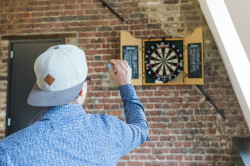
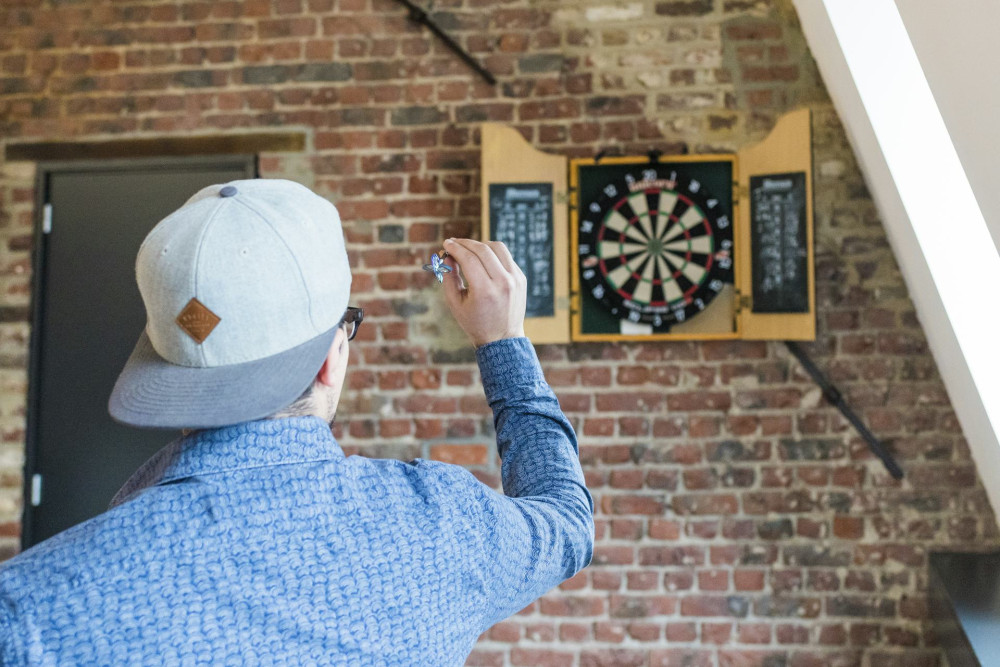
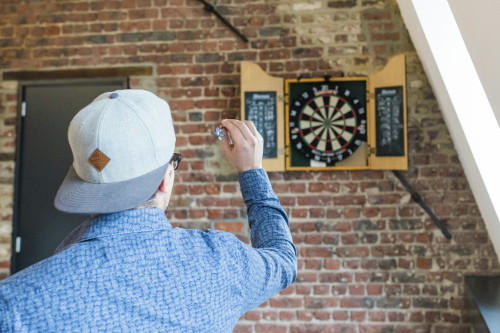
The throw itself is a smooth, controlled motion, with the elbow acting as a hinge. The arm moves forward steadily, and the wrist gives a gentle flick at the moment of release. This combination of control and release creates a clean, accurate throw.
A useful tip is to focus on your follow-through – the motion after the dart leaves your hand. If your hand naturally points toward the target afterward, it’s a sign of a clean motion. If your hand stops abruptly, you may be tensing up too much.
Eye Focus and Mental Calm
Accuracy isn’t just physical – it’s mental. Many players develop a pre-throw routine: a few deep breaths, a steady look at the target, and a consistent rhythm. This helps the mind settle and focus.
When aiming, pick one specific spot on the board – not the entire section. The more precisely you focus, the more precisely your body will follow. It’s a mental discipline that can be trained just like your physical technique.
Small Adjustments – Big Results
Even minor changes in grip, stance, or rhythm can have a major impact. That’s why it’s important to experiment systematically. Change one thing at a time and observe how it affects your throws. You might even keep notes to track what works best for you.
Many players discover that success isn’t about throwing harder, but about throwing more smoothly. A controlled, consistent motion often produces better results than power and speed.
Purposeful Practice
Improving your darts game doesn’t necessarily mean practicing longer – it means practicing smarter. Set specific goals for your sessions: hit the 20 segment ten times in a row, or practice closing a particular number. By focusing on specific aspects of your game, you’ll see progress faster.
Consider recording your throws on video. Watching yourself can reveal small movements you don’t notice in the moment and help you understand where to improve.
Accuracy as a Process
Accuracy in darts isn’t something you achieve once and keep forever – it’s an ongoing process. Even top players constantly adjust their technique to stay sharp. It’s about knowing your rhythm, trusting your motion, and being patient with your progress.
Once you start noticing how small details influence your throw, the game becomes even more fascinating. In darts, as in many things, it’s the little details that make the biggest difference.
Læs også: